Venice - Venezia
One of the most famous places in this world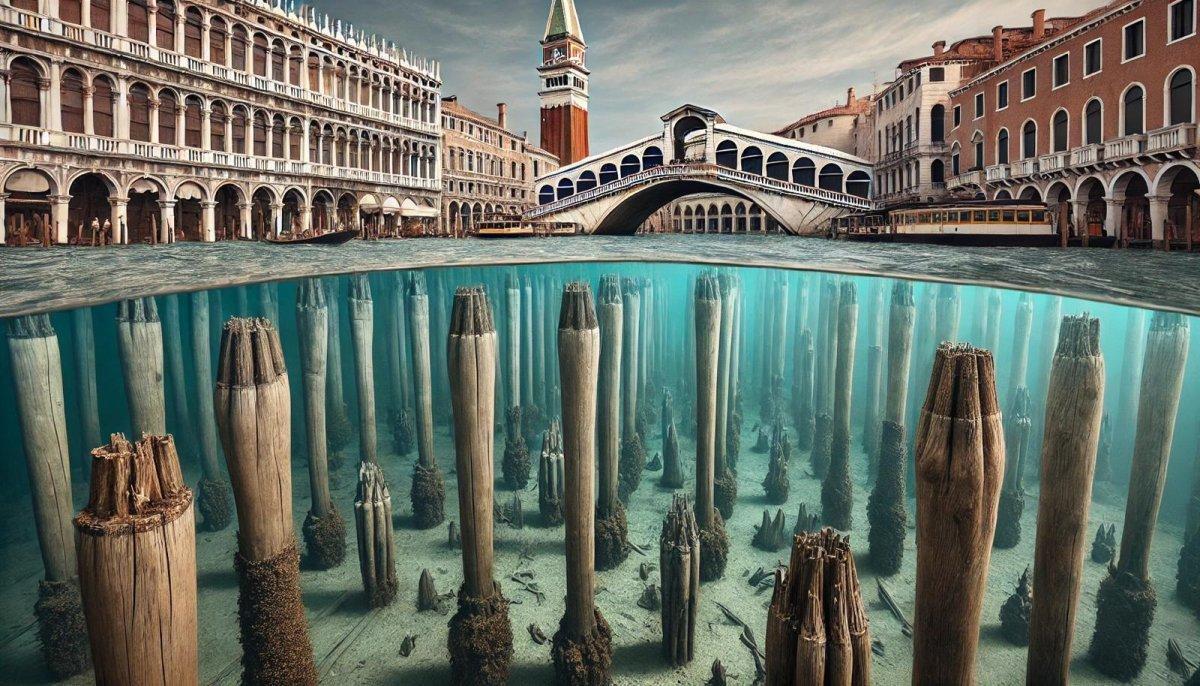
Venice – how Venice was built and how it stands today
The Most Serene Republic of Venice and its great secret: how was Venice built? A question that has been asked time and again, generation after generation. You should know that it was built on wooden piles. Wooden piles that even today support the weight of millions of tourists who, every year, stroll peacefully through its narrow streets.
Indeed, Venice is one of the most fascinating cities in the world, and anyone who visits it or sees it in photographs is always left with this question mark. A unique city that stands on a lagoon. The answer is almost unreal; in fact, you’ll never believe it. It seems almost impossible, but it is a city built entirely on water, which has stood for over a thousand years without sinking. A complex construction technique, which, for the time of Venice’s foundation, was considered cutting-edge. It is an ingenious combination of: nature, weight, the study of the lagoon and seabed, combined with a unique architectural technique that requires a great deal of patience.
Its foundations are not on dry land, but entirely on wooden piles.
The secret foundations: millions of wooden logs
When we think of a house, we imagine or assume that it has concrete foundations. This rule does not apply to the splendid lagoon city, where everyone who visits it wonders: how was Venice built? How does it stand? Perhaps it floats like a buoy on the open sea?
The earliest evidence of construction dates back to 400 AD, when the inhabitants of the hinterland took refuge on the small islands of the lagoon to escape the wrath of the Barbarians. However, precisely to speed up their escape, they began to use poles driven into the seabed, which was muddy ground.
These piles, mainly made of oak, alder and larch, were driven into the mud using actual hammers until they reached the compact layers of the subsoil. What was noticed even back then? The first thing was that there was a ‘quicksand’ effect, meaning the pile was literally sucked into the ground. The second characteristic was the lagoon’s currents, which carried further muddy soil onto the base. The piles were not placed ‘at random’, but arranged densely and strategically, creating a supporting force even at the top. This created a stable base at the water’s surface.
Furthermore, the wood, constantly immersed in the brackish water of the lagoon—composed of seawater and the fresh water from the rivers flowing into this area—does not rot easily. It is preserved thanks to the salt and the lack of oxygen, which prevents deterioration.
How does Venice actually stand?
The real mystery of Venice, built on water, is this: how does it stay standing? The piles form the foundations – we’ve established that – but a supporting surface is also needed; otherwise, where would we put the houses, squares and streets? Platforms made of Istrian stone, a type of stone resistant to salt water, were laid on top of the piles. The stability of the structure then depends entirely on the enormous weight of these platforms. If we think about it, this construction is incredible because it relies solely on the balance provided by the weight of the materials themselves and, subsequently, of the city.
The weight of the buildings is distributed across this ‘submerged forest of piles’, which in turn rests on the muddy seabed of the lagoon. Note that this means Venice does not float, but rests on a stone foundation that adapts to any movements of the piles like a trampoline.
In fact, Venice’s houses, as well as its streets and bridges, adapt to the natural movements of the stone and piles, without causing cracks or damage to the structures. It is therefore not a matter of floating, but of building on water in the truest sense.