The underrated village next to the hotspot
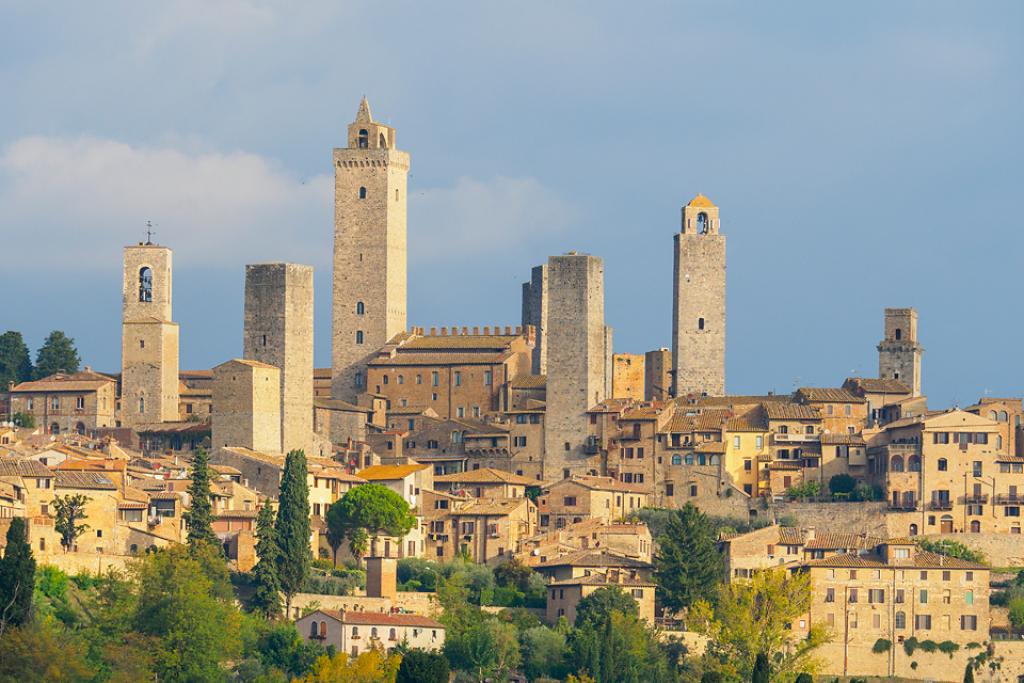
Everyone knows San Gimignano. The towers, the postcards, the coaches that struggle up the narrow access road in summer. Fifteen minutes’ drive further on lies Certaldo, a town with a medieval old town that’s at least as picturesque, and Boccaccio’s birthplace to boot – and yet hardly any German buyer looks there first. It is precisely in this gap between fame and actual value that lies something I repeatedly refer to in conversations with buyers as the ‘20-kilometre effect’, because it’s usually within this distance that everything is decided.
It’s not an insider tip in the strict sense, but rather a calculation that very few people make before falling in love with a place name.
Why a name alone determines the price
A place name is a brand, whether the village likes it or not. San Gimignano, Cortona, Positano, Portofino – these names appear in travel guides, in Instagram captions, in films. Anyone searching online for a property ‘in Tuscany’ often unconsciously includes one of these names because it’s the only one they know. As a result, demand is concentrated on a handful of places, whilst the immediate surrounding area – which is almost identical in terms of geography, climate and cuisine – barely features in the search results.
This concentration drives up prices in the well-known towns themselves, regardless of whether the individual house there is better built, better situated or better equipped than one twenty kilometres further away. Put simply, you’re paying partly for the name on the postcard.
A few examples to illustrate the point
The pattern is particularly evident around San Gimignano. If, instead of the town centre itself, you look towards Certaldo, Gambassi Terme or Montaione, you’ll often find similar country houses, comparable views and the same wine region – at noticeably lower prices per square metre. The difference rarely lies with the house itself. It lies with the place-name sign.
It’s similar in the Val d’Orcia: Montepulciano and Pienza have been magnetising buyers for years, with prices to match. Just a few kilometres further on, towards Chianciano Terme or Sarteano, the landscape hardly changes. The infrastructure remains broadly the same. However, demand drops noticeably because these places feature less frequently on the relevant property search sites and travel blogs.
On the Amalfi Coast, the effect is almost extreme: Positano is so sought-after that even smaller flats command prices which, in comparable locations further east – for example, towards Praiano or Furore – are significantly lower, despite offering virtually identical sea views and the same cliffs. Anyone who has experienced the difference between these places first-hand on a drive usually finds themselves surprised at just how much the price depends on a single place name.
What really matters in the end – and what doesn’t
The ‘20-kilometre effect’ only works if the basics are right. That’s why, before deciding on a lesser-known village, it’s worth taking a sober look at a few points that shape everyday life, not just the first impression.
The journey time to the nearest major town with a supermarket, GP and rail link should be realistic – measured not just on the map, but also along the winding country road you’ll be driving on. Twenty kilometres on a motorway is quite different from twenty kilometres over a hilly pass with hairpin bends – a difference best experienced first-hand before you commit.
The tourist infrastructure is also worth a look, particularly if you’re planning to let the property out later. A village with no restaurants whatsoever and no links to walking trails or places of interest works well as a personal retreat, but perhaps less so for a holiday let. The ideal scenario often lies exactly in between: close enough to a tourist hotspot to benefit from its appeal, yet far enough away to remain affordable and peaceful.
Finally, it’s worth looking at the long-term development of the surrounding area. Some villages are underestimated today precisely because so little actually happens there – no new restaurants, no investment in the village centre, a shrinking population. Others are underestimated even though there are already visible signs of regeneration: a newly opened winery, a young couple who have reopened the old pub, a craft business moving in. Making this distinction is not an exact science. But an afternoon spent in the village itself, a chat in a café and a glance at the number of houses for sale often tell you more than any statistics.
How to find the right neighbouring village
In practice, the search works best using a map, rather than a list of place names. Anyone who has fallen in love with a particular landscape, a specific climate or a particular wine region should regard the well-known place as the centre of a circle with a radius of twenty or thirty kilometres. And everything within that circle should be given equal consideration. Consider everything within that circle equally, rather than just Googling the one name that first springs to mind.
A simple but effective trick: on your next viewing trip, deliberately drive twenty minutes further than the estate agent suggests, simply to see what’s there. Often, this one detour is enough to realise that the neighbouring village has the same charm – just without the coach tours.
The local estate agent themselves is also an underestimated source of information here. Anyone who is already well-connected in a region usually knows more than just the properties currently listed in the well-known town. They often know which neighbouring villages are gaining in appeal, and frequently before this is reflected in the prices. You rarely get this information from an online advert, but only through direct conversation. That’s why, when searching for a property, it’s a good idea not just to ask about the house itself, but also to seek their assessment of the surrounding area.
The fallacy of the ‘postcard address’
One argument I often hear is: ‘But surely the resale value is more secure in San Gimignano than in Certaldo.’ That’s true to a certain extent, but it overlooks an important point: Anyone buying in a well-known town is already paying the full ‘name’ price today – the scope for price increases is limited because almost everyone already knows that the town is in high demand. Anyone buying in an underrated neighbouring town, on the other hand, is purchasing at a price that has not yet fully factored in future appreciation, provided the fundamentals are sound and the town is developing in the right direction.
This is no guarantee, but it is a pattern that has repeated itself in many regions of Italy over the past twenty years: Chianti was once the insider’s tip alongside the established city of Florence; today, it is itself the hotspot, whose surrounding area – towards Valdarno or southern Chianti municipalities such as Radda – is currently undergoing the next stage of this development.
An example that sticks in the mind
A couple from Munich were determined to buy near Montalcino, because of the Brunello, the landscape and the name they knew from their holidays. The properties in the immediate vicinity were significantly above what they’d budgeted for. It was only a suggestion to look towards Castiglione d’Orcia or San Quirico that led to a breakthrough: They found a country house with an almost identical view of the same hills, ten minutes further away, at a price that even allowed for an additional guest house on the plot.
Two years later, they told me that they hardly notice the difference in their day-to-day lives. Except at the Saturday market, which they now actually prefer to the one in Montalcino because it’s smaller and more personal. The Brunello tastes just as good from there.
Where the value for money is particularly good now
n Tuscany, it’s currently particularly worth looking at the areas around San Gimignano and Volterra. There, the tourist infrastructure of the well-known towns already extends across the entire region, but prices haven’t yet risen equally everywhere. The southern Maremma, too – in the shadow of better-known coastal resorts such as Castiglione della Pescaia – still offers noticeable price differences despite being similarly close to the coast.
It’s important to remember, however, that the ‘20-kilometre effect’ is not a licence to buy just any cheap village indiscriminately simply because it lies near a well-known town. It is an invitation to consciously broaden your search radius and apply the same level of care – infrastructure, building condition, legal checks – that would be taken for granted in the well-known town itself.
What locals know that guidebooks don’t tell you
Anyone spending a longer period travelling in a region will quickly realise that locals think differently about this issue than tourists do. Ask a winemaker in Chianti where he’d live himself if his budget were limited, and you’ll rarely get the name of the well-known neighbouring town in reply. Instead, he’ll likely mention a hamlet you won’t find on any postcard, explaining: ‘It’s quieter there, the water’s better, and the bar makes the best coffee in the whole valley.’
This insider’s perspective can’t be Googled. But you can find it out if you’re prepared to spend a few days in the area, rather than just rushing round the usual three or four properties in the well-known town. A coffee at the bar, a chat with the baker, asking the estate agent where he’d buy if it were his own money – conversations like these often provide more insightful clues than any price statistics.
A word of caution
The ‘20-kilometre effect’ sounds like a handy rule of thumb, and that is precisely what you should be wary of: it isn’t one. Some neighbouring towns are less in demand for good reason – inadequate water supply, no reliable rubbish collection, a local council that hasn’t made any investments for years. The price difference compared to a well-known neighbouring town is then not a hidden bargain, but simply the market price for a genuinely lower quality of life.
The difference between a genuine hidden gem and a place that is rightly overlooked usually only becomes apparent on closer inspection: how many houses are standing empty or up for sale? Is there still a functioning village community, a school, a shop? Is the local council investing in roads and infrastructure, or is it merely maintaining the status quo? These questions cannot be answered from a distance, but they are worth considering before opting for the supposedly clever neighbouring town instead of the well-known hotspot.
Timing plays a more significant role than you might think
Furthermore, the ‘20-kilometre effect’ is not a static state, but a snapshot in time. Places that currently lie in the shadow of a hotspot may themselves become sought-after destinations in five or ten years’ time – or they may not. Those who invest early enough benefit twice over: from the lower entry price and, if the development does indeed take place, from the increase in value that comes with growing popularity.
There is no reliable early-warning system for this trend, but a few indicators can be observed. If a well-known restaurant or a small boutique hotel opens in a neighbouring town, this is often an initial sign. If younger families or craft businesses from outside the area move in, rather than just the older generation remaining, this also points to a positive trend. If you compare these signs across several potential neighbouring towns, over time you’ll develop a keen sense of where a purchase is already worthwhile today – and where it’s better to wait a little longer.
How to apply this to your own search
In practical terms, this means when searching for your next property, don’t limit yourself to a single town name, but focus on a region with a radius of twenty to thirty kilometres. Make a note of two or three neighbouring towns you’re not yet familiar with. Set aside time for at least a brief visit to each of them on your next trip, even if there aren’t currently any suitable properties listed there. You don’t develop a feel for the area from behind a screen, but rather in the piazza, over an espresso, whilst chatting to the locals who’ve lived there for a long time.
Frequently asked questions about the 20-kilometre effect in the Italian property market
What is meant by the 20-kilometre effect in the Italian property market?
It is the phenomenon whereby property prices can fluctuate significantly within a few kilometres, because well-known place names drive up demand – and thus prices – disproportionately, whilst the immediate surrounding area lags in terms of price.
Is it worth buying in an unknown neighbouring village?
In many cases, yes, provided the infrastructure and accessibility are right. It is crucial to carry out a realistic assessment of journey times, local amenities and the long-term development of the village.
How do you find suitable alternatives to well-known hotspots?
The easiest way is to use a radius search of twenty to thirty kilometres around the well-known town. Furthermore, talking to estate agents with local connections allows you to gauge the development of neighbouring villages more accurately than any online listing.
Is the resale value in underrated villages more secure or less secure?
It is less predictable, but tends to offer greater potential for appreciation, as the ‘name value’ of the well-known neighbouring towns has not yet been fully factored into prices.
In which regions is this effect particularly evident?
Around San Gimignano, in the Val d’Orcia between Montepulciano and Chianciano Terme, and on the Amalfi Coast between Positano and Praiano.
ItalicaHomes is familiar not only with the well-known locations, but also with the neighbouring villages – and will be happy to advise you on where location, price and development potential best align with your plans.